Enduring constraints on grammar revealed by Bayesian spatiophylogenetic analyses.
Abstract
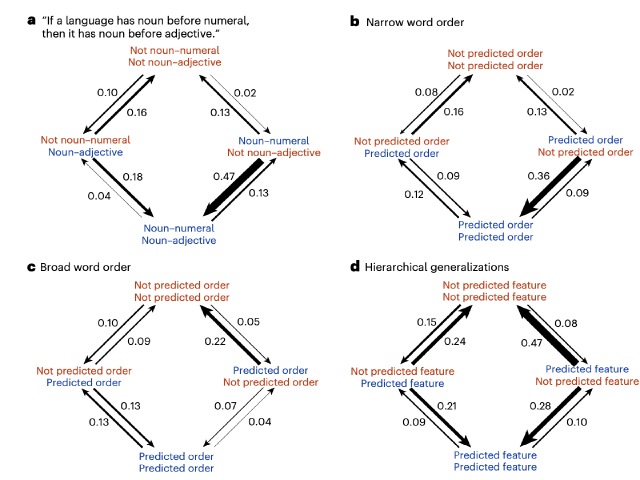
Human languages show astonishing variety, yet their diversity is constrained by recurring patterns. Linguists have long argued over the extent and causes of these grammatical ‘universals’. Using Grambank—a comprehensive database of grammatical features across the world’s languages—we tested 191 proposed universals with Bayesian analyses that account for both genealogical descent and geographical proximity. We find statistical support for about a third of the proposed linguistic universals. The majority of these concern word order and hierarchical universals: two types that have featured prominently in earlier work. Evolutionary analyses show that languages tend to change in ways that converge on these preferred patterns. This suggests that, despite the vast design space of possible grammars, languages do not evolve entirely at random. Shared cognitive and communicative pressures repeatedly push languages towards similar solutions.
Authors
Citation
Verkerk A, Shcherbakova O, Haynie HJ, Skirgård H, Rzymski C, Atkinson QD, Greenhill SJ & Gray RD. 2025. Enduring constraints on grammar revealed by Bayesian spatiophylogenetic analyses. Nature Human Behaviour. 10, 126-136.
Published 17 November 2025
@article{Verkerk2025,
  title = {Enduring constraints on grammar revealed by Bayesian spatiophylogenetic analyses.},
  author = {Verkerk, Annemarie and Shcherbakova, Olena and Haynie, Hannah J. and Skirgård, Hedvig and Rzymski, Christoph and Atkinson, Quentin D. and Greenhill, Simon J. and Gray, Russell D.},
  journal = {Nature Human Behaviour},
  volume = {10},
  number = {1},
  pages = {126--136},
  publisher = {Springer Science and Business Media LLC},
  year = {2025},
  doi = {10.1038/s41562-025-02325-z},
  url = {https://simon.net.nz/articles/enduring-constraints-on-grammar/},
}4 citations · FWCI 31.6 · top 1% cited · OpenAlex