Global predictors of language endangerment and the future of linguistic diversity.
Authors:
Citation:
Details:
Published: 12 December, 2021.
Download:
Abstract:
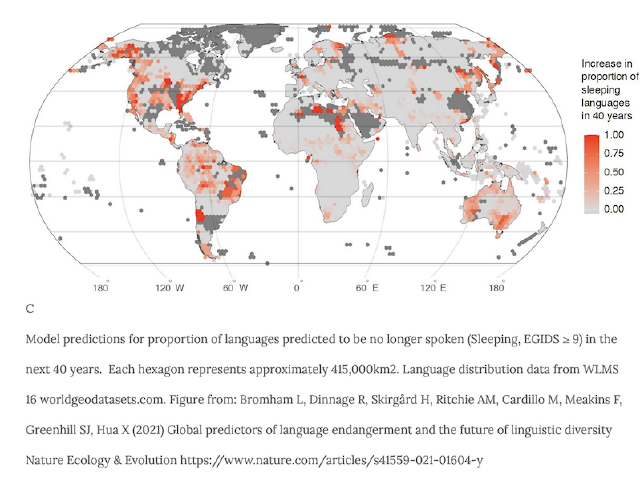
Language diversity is under threat. While each language is subject to specific social, demographic and political pressures, there may also be common threatening processes. We use an analysis of 6,511 spoken languages with 51 predictor variables spanning aspects of population, documentation, legal recognition, education policy, socioeconomic indicators and environmental features to show that, counter to common perception, contact with other languages per se is not a driver of language loss. However, greater road density, which may encourage population movement, is associated with increased endangerment. Higher average years of schooling is also associated with greater endangerment, evidence that formal education can contribute to loss of language diversity. Without intervention, language loss could triple within 40 years, with at least one language lost per month. To avoid the loss of over 1,500 languages by the end of the century, urgent investment is needed in language documentation, bilingual education programmes and other community-based programmes.
Related links / Media:
- ‘Sprachbegabung hat nichts mit Intelligenz zu tun’: Linguist klärt Mythen zu Mehrsprachigkeit auf
- Drivers of language loss
- Languages: One tongue could be lost per month this century | New Scientist
- 1,500 languages could be lost in the next 100 years, study finds - CBS News
- Calls for funding boost to preserve Indigenous dialects as languages rapidly disappear
- Pro Monat wird mindestens eine Sprache verloren gehen
- ‘More than words’: Australia urged to lift its game in preserving Indigenous languages