Language trees with sampled ancestors support a hybrid model for the origin of Indo-European languages
Authors:
Citation:
Details:
Published: 7 July, 2023.
Download:
Abstract:
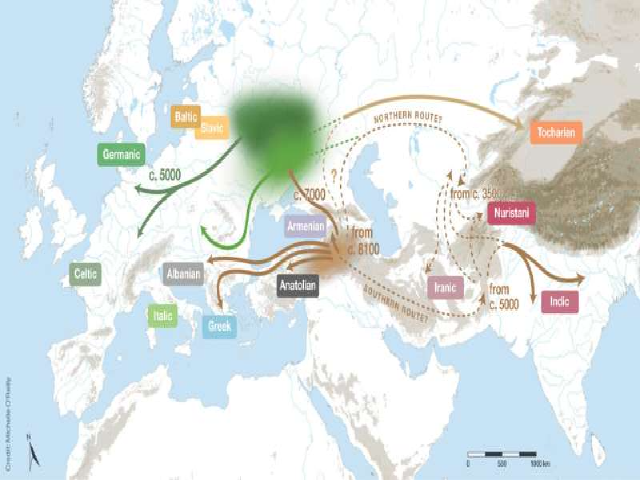
Almost half the world’s population speaks a language of the Indo-European language family. It remains unclear, however, where this family’s common ancestral language (Proto-Indo-European) was initially spoken and when and why it spread through Eurasia. The “Steppe” hypothesis posits an expansion out of the Pontic-Caspian Steppe, no earlier than 6500 years before present (yr B.P.), and mostly with horse-based pastoralism from ~5000 yr B.P. An alternative “Anatolian” or “farming” hypothesis posits that Indo-European dispersed with agriculture out of parts of the Fertile Crescent, beginning as early as ~9500 to 8500 yr B.P. Ancient DNA (aDNA) is now bringing valuable new perspectives, but these remain only indirect interpretations of language prehistory. In this study, we tested between the time-depth predictions of the Anatolian and Steppe hypotheses, directly from language data. We report a new framework for the chronology and divergence sequence of Indo-European, using Bayesian phylogenetic methods applied to an extensive new dataset of core vocabulary across 161 Indo-European languages.
Related links / Media:
- Media Release
- New language database narrows search for first speakers of Indo-European
- Farmers or ranchers? New analysis points to hybrid origin for Indo-European languages
- New language database narrows search for first speakers of Indo-European
- Origin of Indo-European languages traced back to 8000 years ago
- Origin of Indo-European languages date back to about 8,100 years ago, says study
- Las lenguas indoeuropeas se expandieron por Eurasia en oleadas y desde orígenes diferentes
- Study ‘recalibrates’ whole understanding of Indo-European origins